
Brief History Of IAF
 |
Sabre Slayer - Folland Gnat |
 |
HAL HT-2 Trainer Aircraft |
 |
HAL HF-24 MARUT |
First Kashmir War (1947)
During the Indo-Pakistani War of 1947, the IAF conducted a paratrooping operation from Safdarjang, then known as Willingdon Airfield, to Srinagar airfield at 09:30 hours IST on 27 October. This was the most instrumental action of the war as the paratroopers played a crucial role in stalling the advance of attacking tribesmen.
Congo Operation (1961)
Belgium's 75-year colonial rule of the Congo ended abruptly on 30 June 1960. Unable to control the deteriorating situation in its former African colony, Belgium asked the United Nations for assistance. India was one of the first UN-members to respond to the initial appeal for help and sent IAF Canberra bomber aircraft as a part of the UN-led mission in Congo.
Sino-Indian War (1962)
In 1962, border disputes escalated into full-scale war between India and China. Indian military and civilian leadership failed to organise and co-ordinate the air assaults efficiently and eventually the Indian Air Force was never used during the conflict apart from occasional supply missions.
Second Kashmir War (1965)
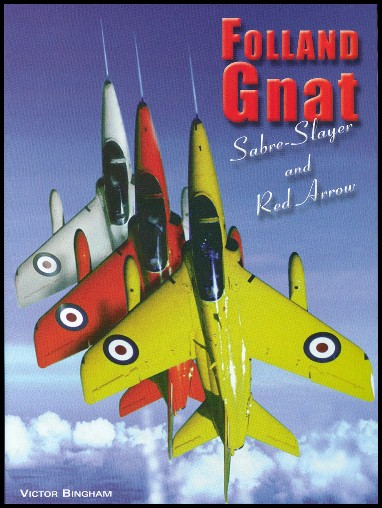
An IAF Folland Gnat being prepared for take-off after receiving orders to scramble during the 1965 war. The Gnats, despite being qualitatively inferior, inflicted heavy casualties on PAF's F-86F Sabre and earned the nickname Sabre Slayer.Three years after the Sino-Indian conflict, India went to war with Pakistan again over Kashmir. Learning from the experiences of the Sino-Indian war, India decided to use its air force extensively during the war. This was the first time the IAF actively engaged an enemy air force. However, instead of providing close air support to the Indian Army, the IAF carried out independent raid missions against Pakistani Air Force (PAF) bases. These bases were situated deep inside the Pakistani territory, making IAF fighters vulnerable to anti-aircraft fire.conflict.
On September 1, 1965, the IAF fighters intervened in an on-going battle between Indian and Pakistani forces in Chhamb. The intervention proved crucial because even though some Indian tanks were destroyed in friendly fire.reinforce. Two days later, IAF Folland Gnat fighters shot down a PAF F-86 Sabre over Chhamb area. Despite being qualitatively inferior, the Gnats were extremely effective against the F-86, earning them the nickname Sabre Slayers. According to one Western source, the Gnats accounted for at least 6 Sabre kills.
During the course of the conflict, the PAF enjoyed qualitative superiority over the IAF because most of the jets in IAF's fleet were of World War II-vintage. Despite this, the IAF was able to prevent the PAF from gaining air superiority over conflict zones. By the time the conflict had ended, Pakistan claimed to have shot down 113 IAF aircraft while the Indians claimed that 73 PAF aircraft were downed. More than 60% of IAF's air combat losses took place during the disastrous battles over Kalaikunda and Pathankot. However, the IAF lost most of its aircraft on ground and the attrition rate (losses per 100 sorties) of the IAF stood at 1.49 while PAF's attrition rate was 2.16, indicating that the IAF fared better in air-to-air combat.
Growth and reorganization (1965–1972)
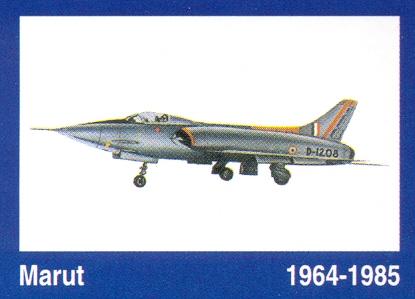
HAL HF-24 Marut, the first fighter jet manufactured indigenously in South Asia.
After the 1965 war, the IAF underwent a series of changes. In 1966, the Para Commandos regiment was created. With an intention of increasing its logistics supply and rescue operations ability, the IAF inducted 72 Avro 748s which were built by Hindustan Aeronautics (HAL) under license from Avro. The aircraft were modified to play a variety of roles and some were later (starting 1987) fitted with a large radome to act as an Airborne Early Warning (AEW&C) platform. India started to lay more stress on indigenous manufacture of fighter aircraft. A total of 147 HAL HF-24 Marut, designed by the famed German aerospace engineer Kurt Tank, were inducted into the air force. HAL also started working on a new improved version of the Folland Gnat, known as HAL Ajeet.
During the late 1960s, the IAF also started inducting MiG-21s and Sukhoi Su-7s fighters which had a top speed of Mach 2. The induction of these advanced fighter jets was the beginning of close collaboration between India and the Soviet Union. With Soviet help, coupled with increasing role of Hindustan Aeronautics, the Indian Air Force was now rated as one of the most sophisticated air forces in the World.
Bangladesh Liberation War (1971)
IAF C-119 aircraft dropping Indian Paratroopers near Tangail, about 150 km from Dhaka, 11 December 1971.The professional standards, capability and flexibility of the newly re-organized Indian Air Force were soon put to test in December 1971 when India and Pakistan went to war over erstwhile East Pakistan. On 22 November, 10 days before the start of a full-scale war, four Pakistani Air Force (PAF) F-86 Sabre jets attacked Indian and Mukti Bahini positions near the international border. In what became the first ever dogfight over Bengal's skies, three of the 4 PAF Sabres were shot down by IAF's Folland Gnats. December 3 saw the formal declaration of war between India and Pakistan following massive preemptive strikes by the PAF against Indian Air Force installations in Srinagar, Ambala, Sirsa, Halwara and Jodhpur. But the plan failed as the Indians had anticipated such a move and no major losses were suffered.
The Indian Air Force was quick to respond to Pakistani air-strikes, following which the PAF carried out mostly defensive sorties. Within the first two weeks, the IAF had carried out more than 4,000 sorties over East Pakistan and also provided close air support to the advancing Indian Army. IAF also assisted the Indian Navy in its operations against the Pakistani Navy and Maritime Security Agency in the Bay of Bengal and Arabian Sea. On the western front, the IAF destroyed 29 Pakistani tanks, 40 APCs and a railway train during the famed battle of Longewala. The IAF pursued strategic bombing of West Pakistan by destroying oil installations in Karachi, the Mangla Dam and a gas plant in Sindh. Similar strategy was also deployed in East Pakistan and as the IAF achieved complete air superiority on the eastern front, the ordnance factories, runways, and other vital areas of East Pakistan were severely damaged.
By the time Pakistani forces surrendered, the IAF claimed that 94 PAF aircraft, including 54 F-86 Sabres, were destroyed. A total of 45 IAF aircraft were destroyed during the conflict, of which 60-80% were lost due to ground fire. The IAF had flown over 7,000 combat sorties on both East and West fronts and its overall sortie rate numbered over 15,000. Comparatively, the PAF was flying fewer sorties by the day fearing loss of planes. Towards the end of the war, IAF's transport planes dropped leaflets over Dhaka urging the Pakistani forces to surrender; East Pakistani sources note that as the leaflets floated down, the morale of the Pakistani troops sunk. The IAF had registered about 80% serviceability which helped it in attaining an edge over the PAF in air-to-air combat. The Indian Army too acknowledged the immense role which the IAF played towards a speedy, decisive and favorable end to the conflict.
See also: Operation Chengiz Khan, East Pakistan Air Operations, 1971, Helibridge over Meghna, Tangail Airdrop, and Battle of Hilli
Siachen conflict (1984-)
The IAF used the Mi-8 Hip extensively to airlift Indian troops to Siachen.
Operation Meghdoot was the name given to a military action launched by the Indian Armed Forces to capture the Siachen Glacier, in the disputed Kashmir region. IAF's special helicopters, capable of flying in extremely thin air, airlifted hundreds of Indian troops to Siachen. Launched on 13 April 1984, this military operation was unique because of Siachen's inhospitable terrain and climate. The military action was an obvious success, given the fact that under a previous agreement, neither Pakistan nor India had stationed any personnel in the area. The Indian forces, facing no odds, took control over most of the heights on the glacier. The operation was hailed in India as strategic, timely and significant, however, its legality under International Law remains questionable.
Operation Cactus (1988)
In November 1988, the People's Liberation Organisation of Tamil Eelam (PLOTE), comprising of about 200 secessionists, invaded Maldives. At the request of the President of Maldives, Maumoon Abdul Gayoom, the Indian Armed Forces, with assistance from R&AW, launched a military campaign to restore government rule in Maldives. On the night of November 3 1988, the IAF airlifted a parachute battalion group from Agra and flew them non-stop over 2,000 kilometres (1,240 mi) to Maldives. The Indian paratroopers landed at Hulule and secured the airfield and restored government rule at Malé within hours. The brief, bloodless operation, labeled Operation Cactus, also involved the Indian Navy.
Kargil conflict (1999)
 An Antonov An-32 of the IAF delivers supplies to the Indian forces in Leh. The IAF runs an extensive air logistics operation to support Indian troops stationed in Kashmir.
On May 20, 1999 the Indian Air Force decided to intervene in the on-going Kargil conflict to provide close air support to the Indian Army, in what would be IAF's most challenging mission carried out in terms of altitude (6,500 ft above sea level). The Army was involved in a military operation to expel thousands of Kashmiri rebels, who had taken control of strategic peaks overlooking Indian army positions. Due to Kashmir's high altitude and rigid terrain, the IAF initially expressed its reservations to deploy the slow-moving Mil Mi-8/17 helicopters which had a service ceiling of 10,000 feet. These concerns materialized when the Pakistani forces shot down an IAF helicopter and two fighter jets, MiG-21 and -27 that had strayed into Pakistan's airspace.
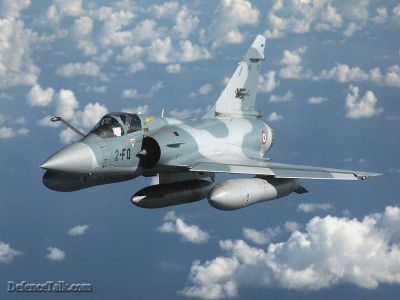
After the initial setbacks, the IAF started deploying the Mirage 2000 fighter bombers which not only had better defense equipment compared to the MiGs, but also gave IAF the ability to carry out aerial raids at night. The Mirages successfully targeted rebel camps and logistic bases in Kargil and within days, their supply lines were severely disrupted.The IAF also deployed its radars and the MiG-29 fighter jets in vast numbers to keep check on Pakistani military movements across the border. The MiG-29s were also used extensively to provide fighter escort to the Mirage 2000. At the height of the conflict, the IAF was carrying out over forty sorties daily over the Kargil region alone. The IAF's operations in Kargil not only boosted the morale of the Indian Army, but also paved the way for the early recapture of Muntho Dhalo and Tiger Hill. By July 26, the Indian forces had successfully countered the rebels but were highly criticized for taking more than two months to tackle the situation, which they had initially claimed to be dealt with in a two-week time frame.
Atlantique incident
According to Indian sources, on 10 August 1999, a Pakistan Navy French-built naval Breguet Atlantic was flying over the disputed region of Rann of Kutch. The aircraft was shot down by an infrared homing R-60 air-to-air missile fired by an IAF Mikoyan-Gurevich MiG-21 which was piloted by Squadron Leader P.K. Bundela. All 16 Pakistani Navy personnel aboard the Atlantique were killed in the incident. The incident remains controversial as Pakistan condemned India for what it called, an 'act of aggression' since most of the debris of the aircraft was recovered within Pakistani territory. According to Pakistan, the aircraft was on a training mission, unarmed & with trainees on board.
 India on Monday became the first country in South Asia to own an Airborne Early Warning and Control System (AWACS), called 'an eye in the sky', with the Israeli-made 'Phalcon' reaching Jamnagar airbase on the country's western coast on Monday morning.
